An Evening At MyPragati’s Classroom
There are moments in community work that rarely make it into annual reports. They are not major events, new partnerships or celebrations. They are the ordinary commitments that must be fulfilled again the following day. At MyPragati, one of those commitments is the regular tuition programme in Lower Aloo Bari Busty, Darjeeling. What began in October 2022 with a small group of students has developed into an established after-school learning initiative.Today, five local tutors support more than 30 students across Classes II to X, with classes conducted from Monday to Saturday.
A programme covering Classes II to X must account for students at very different academic stages. Younger learners may need support with foundational concepts and schoolwork, while older students face more demanding subjects, examinations and questions about their educational futures. Teaching in this environment is not simply a matter of delivering the same lesson to everyone. The tutors must support students according to their levels, helping them work through subjects and develop greater confidence in their studies. Saraswati Sharma, a founding member and lead coordinator of MyPragati, teaches Science and Mathematics and helps oversee the educational programme. Her role illustrates the importance of local educators who are familiar with the children and can maintain relationships over time.
How We Run Tuition Days at MyPragati
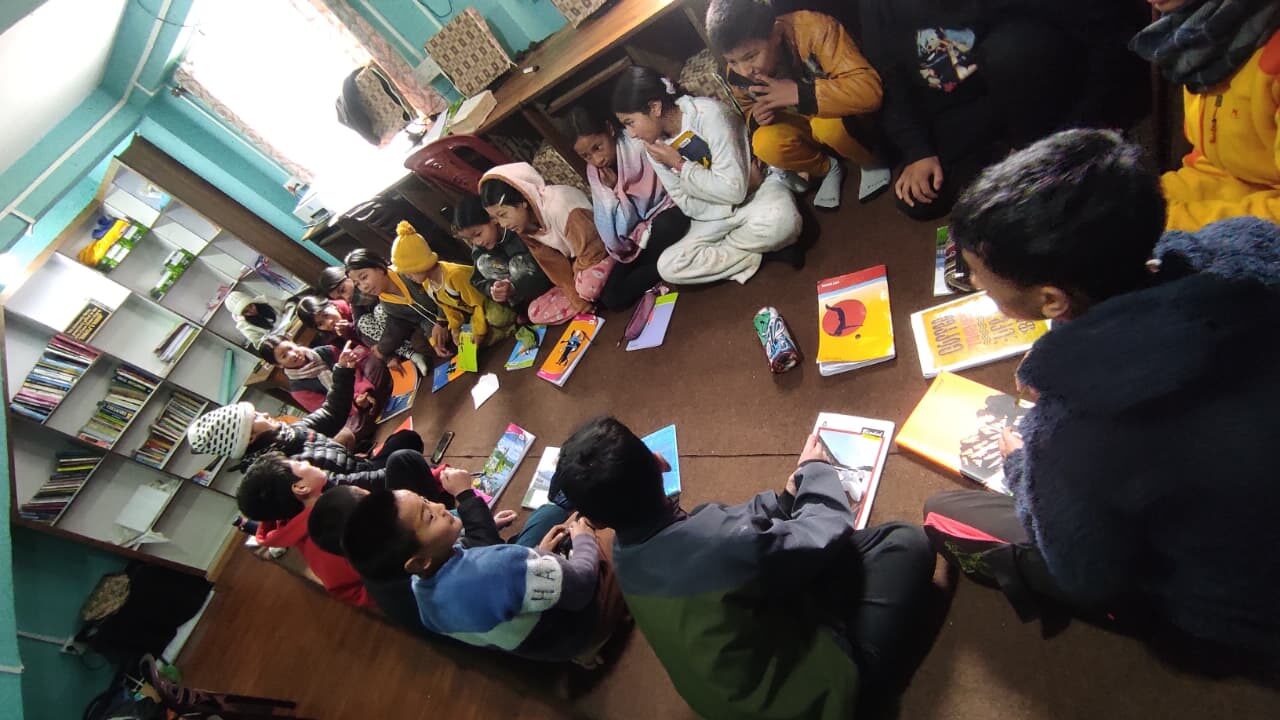
Students are grouped according to their respective classes; a Class IV child sits with other Class IV children, and a Class IX student studies alongside classmates preparing for the same board syllabus. Every child in a group is working through the same chapters, the same homework, the same upcoming tests. When a whole group shares a syllabus, one of our tutors can explain a math concept once to everyone, then move around and help each child one by one. The older students work more independently, and the younger ones get the closer attention they actually need, the kind of attention that, for many of these children, simply isn't available anywhere else.
And there's something this builds that we didn't fully plan for real friendship and peer support. Children who walk to school together, sit in class together, and study together in the evening start looking out for each other without anyone asking them to. A child who's just understood fractions turns and explains it to the friend next to them, and both of them walk away a little stronger. That's the kind of quiet, lasting change a little support makes possible.
A Typical Class: Homework Comes First
Every MyPragati tuition session runs two and a half hours, and it always starts in the same place. Our students attend tuition for 2.5 hours after school, following a 1.5-hour walk home and the very first thing we do is help them finish their homework, because that's where they need the most support.
Why start there?
Because for our children, homework is the daily moment where learning either sticks or quietly slips away. In a city home, a parent or an older sibling or a paid tutor might sit beside a child at the dining table. Here in Lower Aloo Bari Busty, most parents are out working long hours in the fields or on the trekking trails, and many never had the chance to study the subjects their own children now bring home. Without someone to turn to, a confusing homework sheet can be the first small step toward a child falling behind for good. So we become that someone. Our tutors sit with each group, go through the day's homework, and make sure every child actually understands how to solve a problem rather than just copying down an answer. If someone struggles on the same exercise, the tutor stops and re-teaches it on the board. Over weeks and months, that steady routine turns hesitant students into children who genuinely believe they can keep up. It's a small daily act, repeated enough times, that quietly changes the shape of a child's future.
Assessments and Exam Preparation
Once homework is done, we move the class on to whatever's coming up next at school; upcoming tests, weekly assessments, examination preparation, and project work, all without putting pressure on the students.This part of the session is planned around each group's own school calendar. Our tutors keep track of when class tests, weekly assessments and term exams are due, and prepare the group in advance. For the younger children, that might mean revising spellings, times tables or a science chapter. For our Class IX and X students, it means working through past questions and practising how to write clear, complete answers for board exams.Project work gets the same care. School projects often need materials, ideas and adult guidance that's hard to come by at home, so at tuition the children get to plan it out, ask questions, and actually put it together with help close at hand.The result, we've found, is that tuition becomes a safe place to ask "silly" questions, something many of these children would never dare do in a crowded school classroom. And a child who isn't afraid to say "I don't understand" is a child who keeps learning, keeps showing up, and keeps believing school is a place meant for them too.
Time to Play
Study is only half the evening. Once their studies are complete, students get time to play and enjoy themselves and we mean that seriously, not as an afterthought. We don't treat play as a reward for finishing work. We see it as part of a child's growth. After a long day of school, walking, and studying, children need to run, laugh, and simply be children again. It helps them release energy, build friendships, and come back to the next day's learning refreshed instead of worn down. For many of our students, this is also the safest, most supervised playtime they get all day. It keeps them together, close to their tutors, and away from the risks that come with idle evenings in a remote area. Through the programme, they play football, volleyball and badminton, and on Sundays, quite a few of them train in karate with a volunteer coach. Some of our students have even gone on to compete in a regional karate tournament in Kalimpong, proof of what these children are capable of when someone simply gives them the chance.
Fun Fridays: Learning Beyond the Textbook
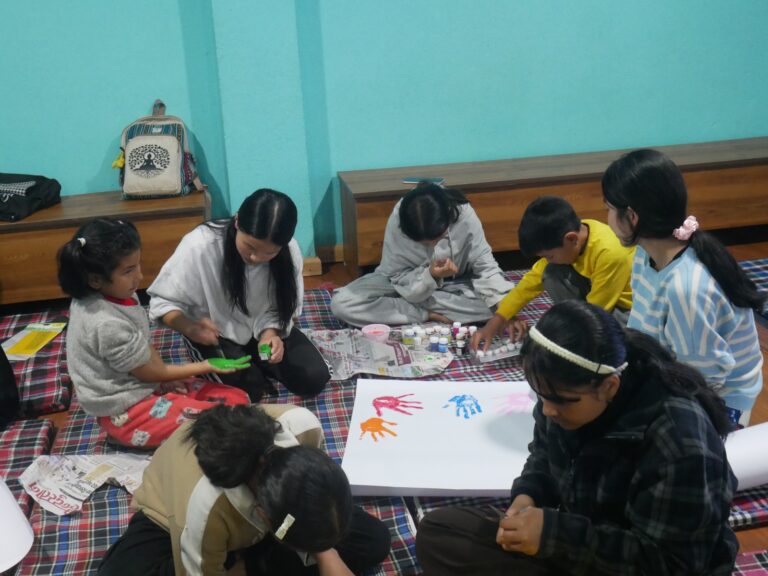
For children whose evenings are otherwise filled with homework and revision, Fridays become something to genuinely look forward to. And they're also where we discover hidden talents: the quiet child who turns out to be a brilliant chess player, or the restless one who suddenly shines the moment they're on stage. These are the moments that remind us why this programme exists in the first place.
Skits help shy children find their voice. Standing up in front of friends, remembering lines, and acting out a story builds confidence and spoken English or Nepali fluency.
Quizzes turn general knowledge into a game. Children learn to think quickly, work in teams, and enjoy facts about the world beyond their village.
Chess teaches patience, planning and concentration thinking several moves ahead is a life skill, not just a board-game skill.
Treasure hunts get children moving while they solve clues, read instructions carefully, and cooperate with teammates.
Reading books build the habit that supports every other subject. A child who reads for pleasure becomes a stronger learner across the board.
More than desks and textbooks
The learning environment itself has also changed over the years.
MyPragati has invested in classroom renovation and improvements, including furniture, storage, learning resources and electrical facilities. These developments may not receive as much attention as examination results, but they form part of the infrastructure required to deliver regular classes. Students participate in sports, debates, storytelling, creative activities and community programmes that complement their academic learning.
The people who make continuity possible
One distinctive aspect of MyPragati's approach is its reliance on paid local tutors.
Instead of depending entirely on occasional visits from outside volunteers, the organisation supports educators who are part of the local community.
Alongside the teaching team, village youth participate through the Pragati Yodhas initiative, contributing to community activities and supporting younger participants.
MyPragati's published impact reports record more than 1,100 classes conducted across its reporting history. Behind that figure are repeated teaching sessions and the organisational effort required to maintain them.
What an ordinary classroom can tell us?
It is easy to recognise a major event or a newly completed building as progress. Regular education is different. Its contribution is built gradually, through lessons, practice, guidance and continued participation. For an initiative such as MyPragati, the important question is not only how many students enter the classroom, but how the learning experience can remain useful as their needs change. An ordinary tuition day may not look like a major milestone. But sustained access to learning is built through exactly this kind of work.